

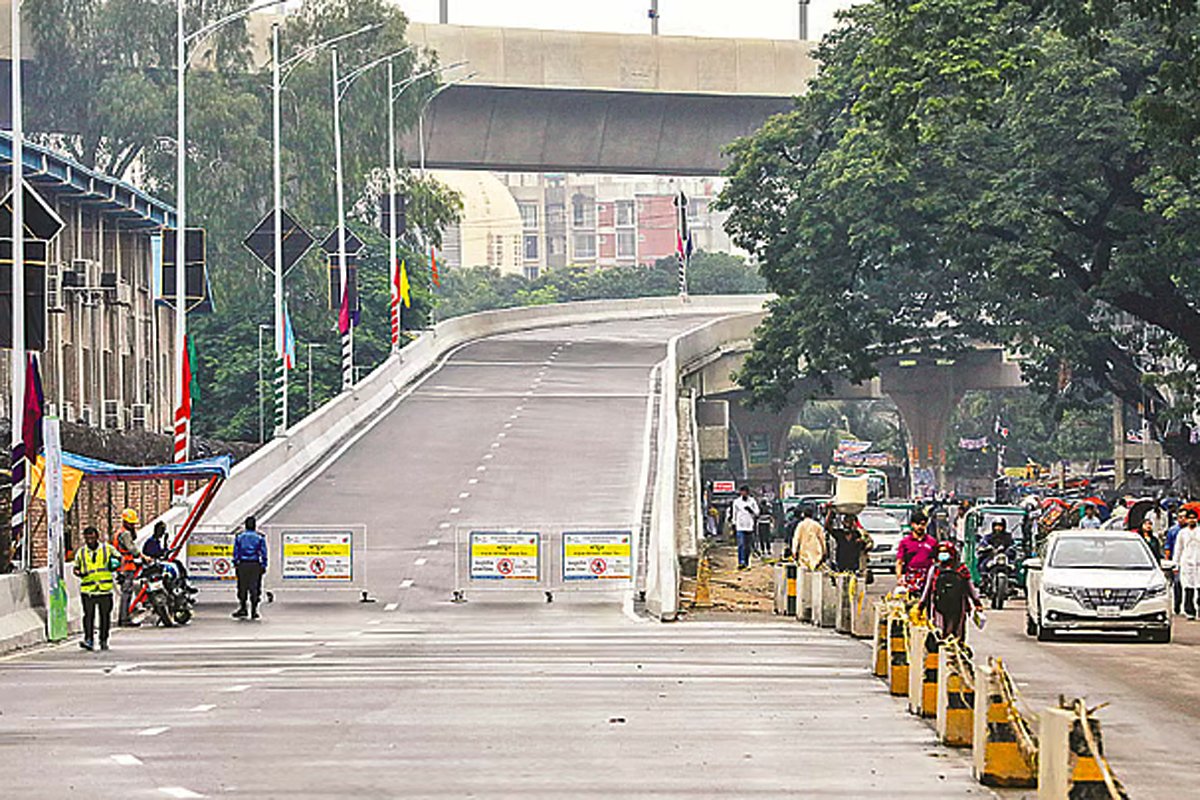
Allegations have surfaced that the foreign investor operating the Dhaka Elevated Expressway—built to ease traffic congestion in the capital—is evading significant government revenue by underreporting the actual number of vehicles using the road. A confidential report by the Special Branch (SB) of police has revealed serious irregularities, including discrepancies in toll collection, the unauthorized appointment of a third party, and the dismissal of Bangladeshi employees.
'Manual' Toll Collection and Revenue Evasion
Under the Public-Private Partnership (PPP) contract, the Bangladesh government is entitled to 25 percent of the toll revenue from additional vehicles if daily traffic exceeds 80,000 for 15 consecutive days. According to SB's covert investigation, nearly 100,000 vehicles currently use the expressway daily. However, to avoid sharing revenue with the government, the investing firm, First Dhaka Elevated Expressway Company Limited (FDEE), is reporting daily traffic figures of only 70,000 to 75,000 vehicles.
The report alleges that during peak hours, staff collect tolls manually using handwritten tickets, bypassing the central software and digital system to keep the count artificially low. As a result, these vehicles are not recorded on the electronic display boards. Data is also reportedly concealed by withholding online receipts and reusing the same receipt for multiple vehicles.
Unauthorized Third Party and Layoffs of Local Staff
FDEE has allegedly engaged another Chinese firm, Shandong Hi-Speed International Operation and Maintenance, in toll collection and maintenance without prior approval from the Bangladesh Bridge Authority (BBA). The SB report notes that no office was found at the address the company registered with the Bangladesh Investment Development Authority (BIDA). Furthermore, the firm faces allegations of failing to renew its trade license, violating labor laws, and employing foreign nationals without valid work permits.
Over the past year, senior Bangladeshi officials at the company have been replaced by Chinese nationals. Employees have also reportedly been transferred to another entity without notice and dismissed on trivial grounds. Terminated workers claimed that nine Bangladeshi staff members were unfairly fired over minor pretexts, such as not keeping small change.
Stance of Authorities and Experts
The SB submitted its report to the Bridges Division on September 3 regarding these irregularities. Bridges Division Secretary Mohammad Abdur Rouf stated that while daily traffic exceeded 80,000 on 21 separate days since the expressway's launch, it did not occur for '15 consecutive days,' meaning the government has not yet received a revenue share under the contract. However, he assured that the SB report is being taken seriously and monitoring will be strengthened to ensure transparency in toll collection. Meanwhile, FDEE authorities declined to comment directly, stating that inquiries should be routed through the BBA.
Professor Adil Mohammed Khan, an urban and regional planner, questioned the project's contract and management, noting that national interests were not fully protected since land value and rehabilitation costs were excluded from the financial calculations. He called for strict government oversight of daily vehicle counts and toll collection, as well as accountability for those involved in irregularities.
Notably, the airport-to-Farmgate section of the 19.73-kilometer expressway—being built from Kawla to Kutubkhali at an estimated cost of Tk 9,000 crore—opened in September 2023. Under the agreement, the investor will hand over the expressway to the Bangladesh government after collecting tolls for 25 years.
Comments